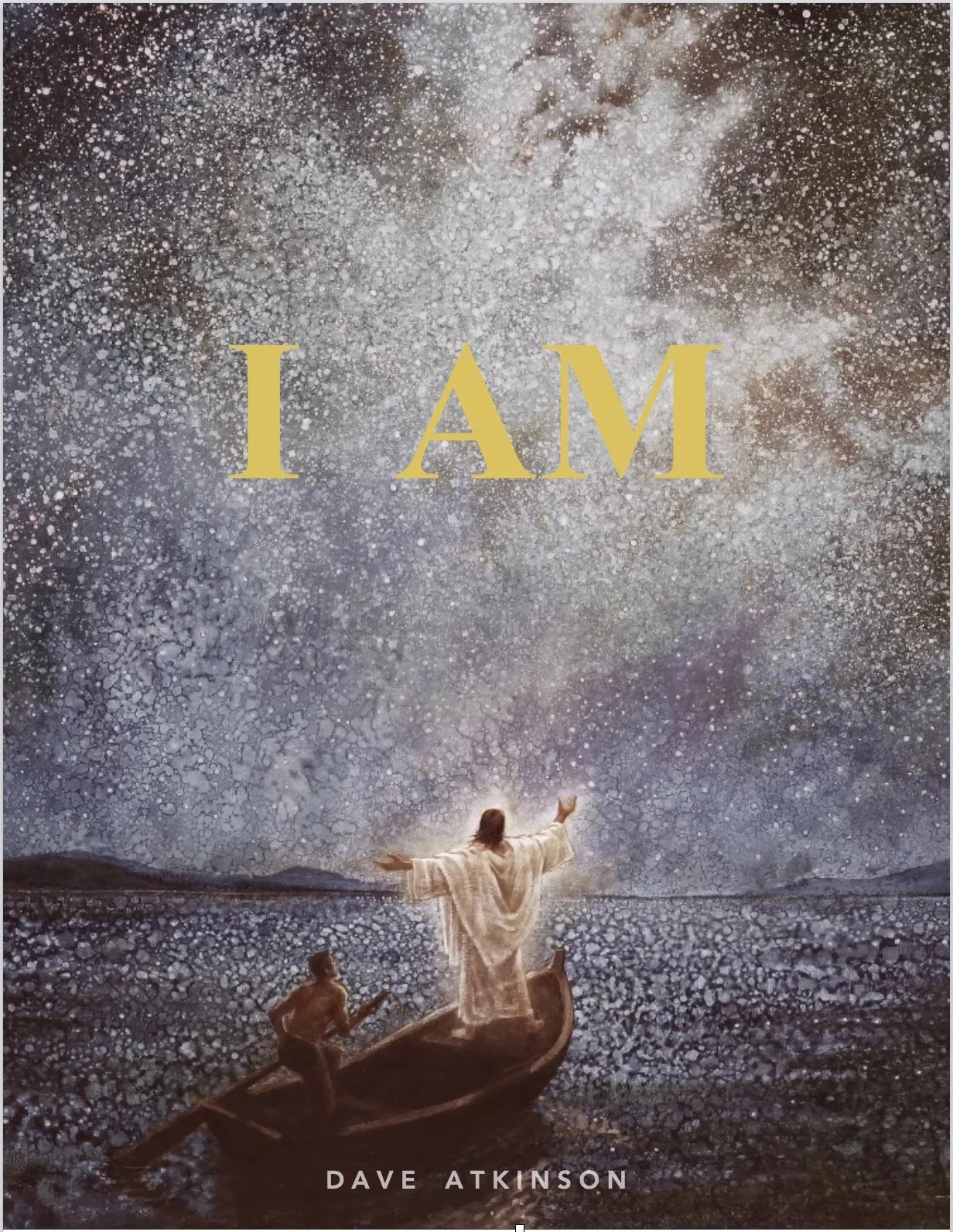
I AM is scheduled for publication in early Fall 2026. Before it releases, I'm making Chapter Two available here — not as a teaser, but as a genuine invitation.
This book is fifteen years in the making. Its subject is identity: who you are in relation to who God is. It draws on physics, scripture, and personal testimony, and it asks the reader to follow an argument before evaluating it. Chapter Two is a fair introduction to how that argument works.
If you read it, I'd welcome your honest response. Not encouragement — though I won't turn it away. What I actually want to know is where the chapter works, where it loses you, and where you find yourself skeptical, moved, or confused.
Send your feedback to feedback@existentiainstitute.com.
Thank you for being part of this before it's finished.
— Dave Atkinson
Existentia Institute
Before It's Published
Chapter 2: Before the Beginning
What I've been shown has implications not just for how human beings understand God and their relationship to him — but for how we understand science, physics, and the fundamental nature of reality itself. The world needs these things perhaps like it never has before. That is the reason I am willing to put myself out there in ways that feel like they cost me something.
So many nights I’ve been up at 2 a.m. writing something down that God showed me.
They say not to cast your pearls before swine and there are going to be some swine out there. But somewhere out there is the person at 2 a.m. who can't sleep, who has been carrying something they have no framework for, who picks up this book and finds out for the first time that what they've been experiencing has a name and a structure and a God who intended it.
That person is who this is for.
I just feel like it is my mission to do this. I wish it wasn't. I am not the hero of this story. I am just the one who was shown it.
So let's go back. Further back than history. Further back than creation. Back to before the beginning of anything we have a name for.
The perfect boundary.
On one side, light. Matter. The kingdom of God. Everything he has created, every soul ever brought home, every world ever built. On the other side, darkness. Antimatter. The consuming force that wants only stillness and reversal. Two sides of the same coin, perfectly separated by the most fundamental boundary in existence — the barrier between matter and antimatter that makes creation possible and whose integrity is the condition on which everything depends.
This boundary is not a feature of the universe that exists independently of God — as though matter and antimatter simply found themselves separated by some impersonal wall. The barrier is his architecture. His construct. He built it, he governs it, and nothing that happens at or across it occurs outside his authority. The darkness presses against it. It does not own it. There is no neutral ground in the structure of reality — there is only what God built, and what operates within it.
And within that boundary — in the threshold itself, in the dividing line between the two kingdoms — is the collective pool of conscious intelligence.
Consciousness is its foundation — the animating awareness present in everything God creates. Intelligence is its variable expression, distributed across created kinds in degrees.
Not on the dark side. Not on the light side. Prior to both — existing at the deepest layer of God’s architecture, immediately against the interior face of the barrier he constructed. The pool predates the matter and antimatter distinction itself. It is the reservoir from which both sides draw, and to which both sides return.
This is also where science and God meet — not in opposition but in perfect congruence. God is the author of everything. The laws of physics, the structure of matter, the mathematics embedded in creation — these are not alternatives to God. They are his signature. Science conducted in its true definition, without the synthetic framework the darkness has introduced to separate the observer from the source, arrives at the same place theology does. The barrier is real. The pool is real. The intelligence within it is real. The truth concealed by the darkness is simply this: the author of the universe and the subject of genuine scientific inquiry are the same being.
Think of intelligence as water. A pitcher of it, perfectly still. Now take a glass of water and pour it in. Watch the surface settle. Where is the glass of water now? It's there — every molecule of it is present — but it is no longer distinguishable from the pitcher. It has no edge. No name. No separate existence. It is simply water, the way it always was, absorbed back into the whole.
That is what intelligence looks like in the pool. Present but unnamed. Real but undifferentiated. Potential without form. Infinite precisely because it has not yet been defined — and the moment it is defined, its infinite possibility becomes finite, its edges reveal what it is not, and something irreversible has occurred.
Something has become someone.
What the pool is not, however, is finite. God's act of pouring — of reaching in and drawing intelligence out into personhood — does not deplete what remains. Intelligence has an innate capacity to expand. The pool replenishes itself. The source does not run dry. The river can flow outward forever without the reservoir behind it diminishing.
This is also why annihilation — the collision of matter and antimatter that we will address more fully in Chapter 8 — is not the end of intelligence. It is a return. Everything that matter is made from, every form and structure that exists on the light side of the barrier, can be destroyed in that collision. Intelligence cannot. It returns to the pool. But return to the pool is not a neutral event — it is the loss of everything that made it someone. The name. The face. The accumulated experience of an existence. A total reset. This is why the darkness's desire to return intelligence to the pool is not merely a preference for stillness. It is the ultimate erasure.
The pool survives because the pool is the barrier itself. The threshold. The dividing line between the two kingdoms. The darkness wants stillness over this boundary not because it owns it but because it understands what it is. And God keeps pouring from it because he understands what it can become.
This is where the story begins. Not with creation — with a question that preceded it.
What do you do with the pool?
Two answers to that question exist, and everything that has ever happened in the universe — every war, every act of love, every birth and death and choice — flows downstream from the conflict between them.
The first answer is God's. Intelligence is a river. It is meant to flow outward, to be released, to be clothed in form and identity and given a future. To pour the glass of water out of the pitcher and say — you are separate now. You have a name. You are someone. The miracle is that something unprecedented occurs: a being that did not exist before now does. Irreversible. Eternal. A person.
The second answer is the darkness. Intelligence is a reservoir. It is meant to be kept, hoarded, held in stillness. Nothing leaves. Nothing becomes someone. Increase happens only through absorption — pulling back in what has already been released, undoing the irreversible, dissolving the someone back into the something. The goal is not creation. The goal is accumulation through reversal. The perfect end state is total stillness. A full pitcher. Nothing poured out. Nothing named. Nothing lost — because nothing was ever permitted to become anything in the first place.
These are not merely two philosophies. They are two fundamentally opposed orientations toward the same raw material, and they cannot coexist indefinitely. One produces persons. The other consumes them. One is a river. The other is a black hole.
Everything else in this book is a consequence of that conflict.
To understand what God did — and why it cost something — you have to really contemplate what the pool actually is for a moment longer.
Intelligence in the pool has no suffering. It has no longing, no loss, no fear. It also has no joy, no love, no growth, no face. It simply is, the way water simply is. Undisturbed. Eternal in the way that stillness is eternal — not because it is alive, but because nothing is happening to it.
God looked at that stillness and saw something the darkness never could. He saw persons. Not potential persons. Not theoretical persons. Actual, specific, irreplaceable individuals waiting inside the undifferentiated whole the way a sculpture waits inside a block of stone. He saw you. Before you had a name, before you had a face, before anything in the universe existed that you could stand on — he saw you specifically, and he wanted you to exist.
What he understood in that moment matters. This was not a decision made from ignorance. God knew what the pool was. He knew what stillness was. He knew what aloneness was — not as an abstract concept, not as a theological category, but as something he had faced himself before the first act of creation. Before there was anyone else. Before relationship was possible. He existed before all of it, and he knows what it is to exist without another.
There is a difference between knowing something and experiencing it. Foreknowledge is awareness. Experience is participation. God did not reach into the pool because he was unaware of the cost. He reached in because he had counted it and decided you were worth it anyway. He knew what it meant to be alone. He chose, at the foundation of existence, to make sure you never had to be — and then he went further. When the time came, he sent his Son not to observe mortality from a distance but to enter it. To be hungry. To be tired. To be misunderstood by the people who should have known him best. To experience what you experience, from the inside, so that nothing you carry would ever be foreign to him.
This is why your experience matters to him in a way that cannot be reduced to management or oversight. He is not watching from above what he has never known from within. He went first. Everything you have ever felt in your darkest moment — the aloneness, the silence, the sense that no one fully understands what it costs to be you — he chose to know that. Not because he had to. Because he wanted to be able to say, from experience rather than foreknowledge: I know. I was there. I understand from the inside what I am asking of you.
So he reached in.
This is where Jesus Christ enters the story for the first time — not as a historical figure, not yet as the man who would walk the roads of Galilee, but as the only being with both the authority and the ability to cross the barrier between the light and the darkness and bring intelligence home safely. To reach into the pool without being consumed by it. To take what had no boundary and give it one. To take what had no name and name it.
What happened next is the most intimate thing that has ever happened to you. Before your body. Before this world. Before memory.
You opened your eyes for the first time.
Not metaphorically. You — the specific, irreplaceable person reading these words — perceived something you had never perceived before. Light. And without yet having language for it, without yet having the categories to understand what you were experiencing, something in you turned toward it. Not because you were told to. Because that is what intelligence does when it finally sees what it was always meant to become.
You were born.
Not into mortality. Into personhood. Into the family of God.
This is why baptism is not merely a ritual or a religious formality. It is a similitude — a physical re-enactment of the most fundamental event in your existence. You enter the water the way intelligence existed in the pool: submerged, undefined, held in stillness. You are drawn up out of it the same way God reached in and drew you into personhood — emerging into light, into breath, into a new identity that did not exist in the same form a moment before. When Jesus insisted on being baptized by John despite having no sin to wash away, he was not performing an obligation. He was honoring the pattern. The water is the pool. The emergence is the birth. The one who raises you out of it stands in the place of the one who first reached in. Every time a person comes up out of that water, something ancient is being remembered by the spirit before the mind has words for it.
The darkness is at war with God for drawing you from the pool and it has only one objective.
It has never had any other.
Take it back.
Not destroy — the darkness is not primarily interested in destruction. Destruction is a tool, not a goal. What it wants is reversal. It wants the glass of water poured back into the pitcher. It wants the name taken away, the boundary dissolved, the someone returned to something. It wants the pool restored to its original stillness, swelled by everything God has released into personhood, and it wants nothing ever poured out again.
This is why the darkness does not think the way we expect a villain to think. It does not rage. It does not envy in the way a person envies. It wants stillness — total, permanent, undisturbed stillness — and it views every person who exists as an unauthorized withdrawal from a reservoir that was never meant to be touched. You are not hated by the darkness the way one person hates another. You are resented the way a sealed vault resents a broken lock. Your existence itself is the offense.
God's response to this has never wavered. He keeps pouring. He keeps reaching in. He keeps naming what the darkness insists should remain nameless. Every soul that crosses the threshold from the pool into personhood is an act of defiance against everything the darkness stands for — and a declaration that the river will not be stopped.
This is the war. It did not begin on a battlefield. It did not begin with armies or weapons or strategy. It began with a question about a pitcher of water.
What do you do with the pool?
Everything else is downstream from that.
Now bring it back to you.
Not as a theological abstraction. Not as ancient cosmology. As your actual biography.
You were in that pool. You were the glass of water indistinguishable from the pitcher — present but unnamed, real but undefined, infinite in potential precisely because nothing had yet given you a boundary. And then something reached in. The barrier was crossed. Intelligence that had no face was given one. You were clothed in light, raised as a child of God, given a name that has never belonged to anyone else and never will.
This is not metaphor. This is your origin story.
Everything you have ever longed for — to be known, to be seen, to matter to someone specifically — is the echo of that first moment when you were pulled from the undifferentiated whole and told that you were irreplaceable. That longing is not weakness. It is memory. Something in you remembers what it felt like to be named for the first time, and it has been reaching back toward that ever since.
The darkness knows this. It knows that the deepest wound it can inflict is not physical. It is the wound of anonymity — the manufactured feeling that you are nobody, that you are interchangeable, that the universe would not notice your absence. That wound is not accidental. It is a strategy. A deliberate attempt to return you, psychologically and spiritually, to the condition of the pool. Nameless. Undifferentiated. Absorbed.
But here is what the darkness cannot undo.
You have a name. You have always had one. And the one who gave it to you has never taken it back.
You were not an accident. You were not an afterthought. You were not one of billions of interchangeable beings that God assembled on a production line and sent into the world without a second thought.
You were seen before you had eyes to be seen with. You were known before you had a name to be known by. You were wanted before you had any way to want anything in return.
And here is the thing about what God sets in motion — He does not reverse. The glass of water poured out of the pitcher does not go back. The name given cannot be ungiven. The person created cannot be uncreated. The darkness can obscure that. It can make you forget it. It can bury it under decades of pain and silence and manufactured anonymity until you can barely feel the edges of it anymore.
But it cannot undo it.
This is the foundation everything else in this book is built on. Not doctrine. Not argument. Not theology assembled in a library. A fact about the nature of reality that was true before any library existed, before any language existed to put it in, before anything existed at all except a still pitcher of water and the God who looked at it and decided to pour.
He is still pouring.
And you are the evidence.
For you to consider
1. Before reading this chapter, how did you think about where you came from? Has anything shifted in how you understand your own origin?
2. Two orientations toward the same pool: God pours outward, darkness pulls inward. Where do you see these two orientations showing up in your own life and in the world around you?
3. You were brought from the pool into personhood — from something into someone. Does that change how you see yourself? How you see others?
4. Has science ever felt like an obstacle to your faith, or faith like an obstacle to your understanding of the world? What would it mean to hold both as expressions of the same truth?
5. Baptism is described here as a physical re-enactment of your original birth from the pool into personhood — submerged, then drawn up into light and new identity. If you have been baptized, does this reframe what that moment meant? If you haven't, does it change how you understand what is being offered?
There is more on the other side of this chapter than most people have ever been offered on these questions.
If this chapter opened something for you, there is much more ahead. I AM releases in early Fall 2026 — in print and in audio.
Leave your name and email and I'll notify you the moment it's available.